
ESG and Sustainability
The connected terms Environmental, Social, and Governance (ESG) have become common to denote an approach and a set of standards that guide the integration of investment decisions and corporate governance with environmental and social goals, in the context of sustainability and social responsibility. This approach is based on the idea that companies should deal not only with generating a profit, but also with issues of how their business affects the environment and society, and has become a widely accepted trend in financial circles and by corporations around the globe for more than two decades. Investing with ESG considerations is sometimes referred to as responsible investing.
The ESG approach has been globally driven by the UN 2030 Sustainable Development Goals and the Paris Agreement. As our planet increasingly faces the catastrophic and unpredictable consequences of climate change and resource depletion, governments from around the world have committed to a more sustainable growth.
In its resolution “Transforming our world: the 2030 Agenda for Sustainable Development“of 25 September 2015, the General Assembly of the United Nations (UN) has adopted a new global framework for sustainable development, which has established the UN Sustainable Development Goals, encompassing the three dimensions of sustainability: economic, social, and environmental.
The Paris Agreement is a legally binding international treaty on climate change, adopted by 195 Parties at the UN Climate Change Conference (COP21) in Paris, on 12 December 2015[1]. It entered into force on 4 November 2016.[2] Its overarching goal is to hold “the increase in the global average temperature to well below 2°C above pre-industrial levels” and pursue efforts “to limit the temperature increase to 1.5°C above pre-industrial levels.”
At the level of the European Union (EU), in its Communication of 8 March 2018 entitled „Action Plan: Financing Sustainable Growth“, the European Commission set out measures to achieve the following objectives:
- reorient capital flows towards sustainable investment in order to achieve sustainable and inclusive growth,
- manage financial risks stemming from climate change, resource depletion, environmental degradation and social issues, and
- foster transparency and long-termism in financial and economic activity.
The European Green Deal of 11 December 2019 is the new growth strategy of the Union, which aims to transform the Union into a modern, resource-efficient and competitive economy with no net emissions of greenhouse gases (GHG) by 2050.
[1] Of the three UNFCCC member states which have not ratified the agreement, the only major emitter is Iran. The United States, the second largest emitter, withdrew from the agreement in 2020, rejoined in 2021, and withdrew again in 2026.
[2] The Republic of Serbia ratified the Paris Agreement by Law in 2017 (“Official Gazette of RS – International Agreements”, No. 4/2017).
ESG and Sustainability
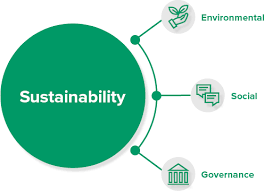
Sustainable growth generally refers to the inclusion of environmental and social considerations in the investment decision and the governance of public institutions and private entities. In practice, ESG encompasses a set of factors that concern each of these issues.
Environmental factors refer to climate change mitigation, as well as the environment more broadly, covering air, water and soil pollution, resource depletion, biodiversity loss and associated risks (natural disasters).
Social factors refer to issues of working conditions, labour relations and employee rights; equal treatment and opportunities for all; economic, social and cultural rights; information-related impacts for consumers and end-users.
Governance factors include issues of management structures and employee relations, risk control and management, code of ethics, prevention of corruption, bribery and conflicts of interest, transparency and reporting.
Advantages of including ESG factors in the company's business policy
Increasing awareness of the importance of the ESG factors and related risks
The inclusion of ESG factors in the business policy increases the awareness of management structures and employees about the impact of the company’s business activities on each of these factors, as well as the associated risks, such as the risks related to climate change, working conditions, human rights, corporate governance, business ethics and other relevant factors.
Risk management and mitigation
Understanding risks enables risk management and mitigation, consequently increasing resilience
Increasing efficiency and cost reduction
Commitment to sustainability goals can encourage innovation, reduce resource and energy consumption, influence an optimal supply chain, and increase productivity.
Access to investments and capital
The integration of ESG factors in the business policy can enhance the company’s access to different sources of financial capital, given that investors assess the risks and opportunities that sustainability issues pose for their investments and value long-term sustainability more than short-term profits. Also, the number of investment products that explicitly seek to meet certain sustainability standards is increasing.
Reputation and building trust
Commitment to sustainability and responsible ESG practices impacts reputation and builds trust with stakeholders, including consumers, suppliers and other business partners, employees, investors and the general public. Modern consumers prefer brands that align with their values.
Compliance with regulatory requirements
Authorities and regulatory bodies are increasingly introducing stricter ESG regulations, requiring companies to report on their sustainability efforts. Businesses that fail to meet these requirements face financial penalties and reputational damage.